
The Turning Point Every Vocalist Reaches
I'll be honest with you. A few years ago, I tracked an entire EP using a $40 USB mic I grabbed off a discount shelf. The vocals sounded dull, muddy, and painfully thin, no matter how many plugins I threw at them in the mix. A senior mix engineer I was working with listened to my stems and said something I've never forgotten: "The problem isn't your voice or your plugin chain. It's your microphone."
That single conversation changed my entire approach to audio.
I upgraded to a proper XLR condenser, patched it into a basic Focusrite Scarlett, and comped the same vocal take. The difference wasn't just subtle — it was staggering. The clarity, the depth, the "air" in the high frequencies... things I didn't even know I was missing suddenly appeared in the DAW.
If you're reading this, you're probably at that exact same turning point. Maybe you're tracking vocals in your bedroom, or maybe you're building a home studio and want to get the signal chain right from day one. Either way, you're in the right place.
This guide covers the top 7 XLR condenser microphones for vocal recording in 2026, tested and evaluated across every major budget range. No fluff, no fake rankings, just honest assessments with real specs and the kind of information that actually helps you make a decision.
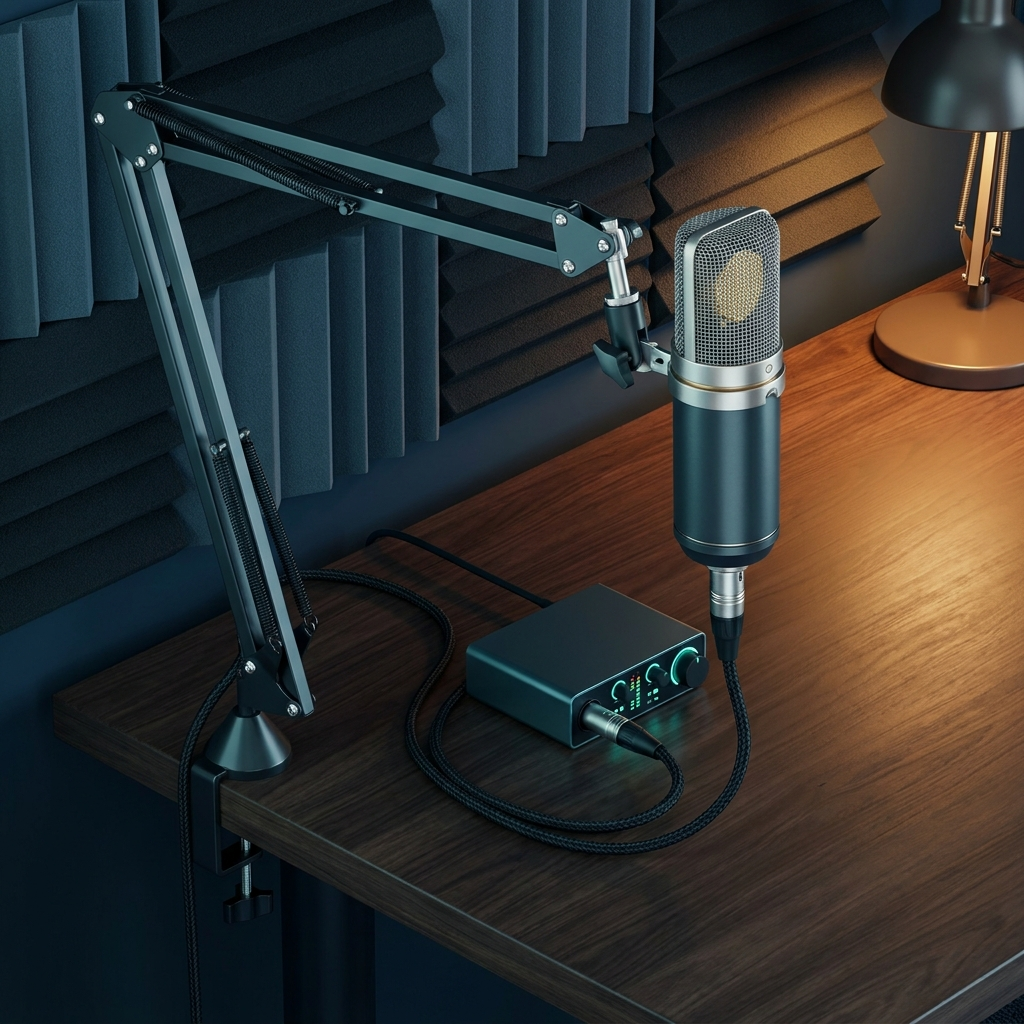
What Makes an XLR Condenser Microphone Different, and Why Does It Matter for Vocals?
Before we jump into the list, you need to understand why this type of microphone is the standard for vocal tracking in professional and project studios alike. This section is quick, but it matters.
How Condenser Mics Actually Work
A condenser microphone uses a charged capacitor plate — the diaphragm — that vibrates in response to sound waves, generating an electrical signal. Because the diaphragm is incredibly light and responsive, condenser mics capture far more detail, nuance, and frequency range than dynamic microphones.
Condensers typically cover 20 Hz to 20,000 Hz, matching the full range of human hearing. Dynamic mics, by contrast, usually roll off earlier, focusing around 50 Hz to 15,000 Hz. For vocals, that extended high-frequency response is what gives you the breathy "air" and natural shimmer that makes a vocal performance feel three-dimensional.
Why XLR Over USB?
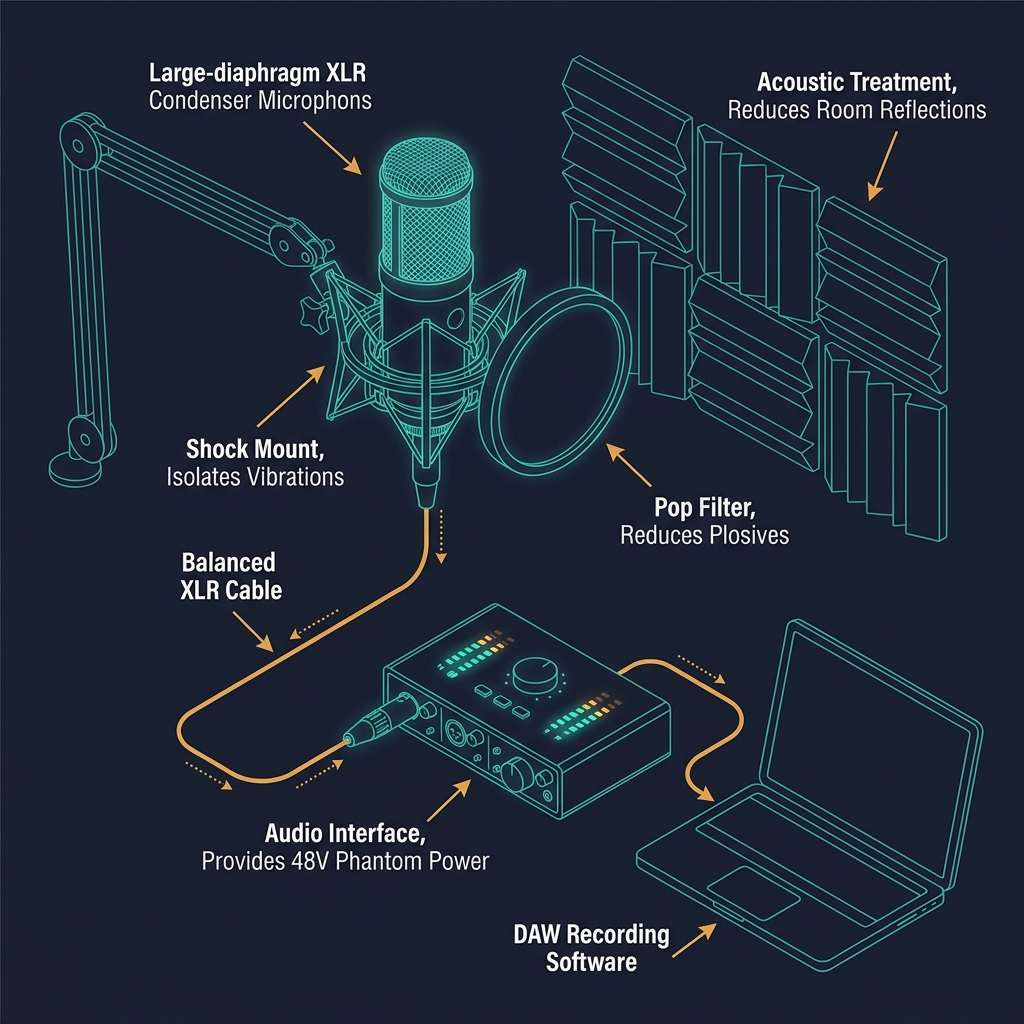
An XLR connection delivers a balanced audio signal. This means the cable actively cancels out electromagnetic interference and noise over long runs. The result is a cleaner, quieter signal hitting your preamp.
USB microphones are convenient, but they bypass the audio interface and rely on the computer's internal conversion. In 2026, the market has shifted toward hybrid XLR/USB options, but for serious vocal tracking, running XLR through a quality audio interface remains the gold standard.
One Important Thing to Know Upfront
All XLR condenser microphones require 48V phantom power. This is supplied by your audio interface or mixer. It's not a flaw or a limitation; it's just how the circuitry works. A good beginner interface like the Focusrite Scarlett Solo (around $120) or the PreSonus AudioBox USB 96 ($100) provides clean phantom power and will easily handle any mic on this list.
Now, on to what you actually came here for.
The Top 7 XLR Condenser Microphones for Vocal Recording in 2026
These seven microphones are arranged from best all-around value to professional-grade excellence. There is something here for every budget and every type of vocalist.
1. Rode NT1 5th Generation: Best Overall for Home Studio Vocals
Price: Approximately $249 | Polar Pattern: Cardioid | Frequency Response: 20 Hz to 20,000 Hz | Self-Noise: 4 dB(A) | Max SPL: 142 dB | Connectivity: XLR and USB-C hybrid | Phantom Power Required: Yes, 48V
If you only read one section of this entire article, make it this one.
The Rode NT1 5th Generation is, in my personal experience, the single best microphone you can buy for under $300 in 2026. I've used it on acoustic guitars, podcasts, and vocal takes for everything from folk music to hip-hop. The thing that consistently surprises people is the silence. At 4 dB(A) of self-noise, it is technically one of the quietest studio condenser microphones ever measured.
What does that actually mean for you? It means when your vocalist pauses between phrases, you hear absolute silence — not a low hiss or subtle hum running under the recording. That silence is worth more than most people realize, especially when you are stacking multiple vocal takes in a dense mix.
The NT1 5th Gen also added a clever hybrid XLR/USB-C socket at its base, so you can plug it directly into a laptop via USB-C when traveling, then switch to XLR for studio sessions. The USB mode even includes 32-bit float recording, which makes it nearly impossible to clip the signal.
The Sound Profile
Open, transparent, and slightly bright in the upper midrange, with a subtle presence peak around 4 to 5 kHz that helps vocals cut through a mix. If your voice is naturally warm and full, this mic will keep it honest while adding a little extra clarity. If your voice is already bright or thin, you might want to look at the Warm Audio WA-47jr below instead.
Includes in the Box: SM6 shockmount, pop filter, XLR cable, USB-C cable, and a pouch. That is genuinely impressive at this price.
Pros: One of the lowest self-noise levels of any condenser mic. Exceptional value for money including accessories. Dual XLR and USB-C connectivity. 32-bit float recording via USB-C prevents clipping.
Cons: Only cardioid polar pattern, no switchable patterns. The lows and lower mids can feel a little unruly without acoustic treatment. USB-C mode does not support 44.1 kHz sample rate.
Best Paired With: Focusrite Scarlett Solo or 2i2, or the Rode AI-1 interface. Who is it for: Singer-songwriters, podcasters, home studio beginners, and anyone recording solo vocals in a moderately treated room.
2. Neumann studio microphones reference TLM 103: The Professional Standard
Price: Approximately $1,100 | Polar Pattern: Cardioid only | Frequency Response: 20 Hz to 20,000 Hz | Self-Noise: 7 dB(A) | Max SPL: 138 dB | Connectivity: XLR | Phantom Power Required: Yes, 48V
The Neumann TLM 103 isn't just a microphone; it's *the* microphone. It's been on more Grammy-winning vocal tracks than most artists can count. Released in 1997 and still in production because it has never needed to be replaced, the TLM 103 has earned its status as the industry benchmark for studio vocal recording.
The "TLM" stands for "transformerless microphone," a design choice that maximizes headroom and reduces noise. Neumann achieved a self-noise of just 7 dB(A) without a transformer in the signal path, which results in an exceptionally clean, open sound.
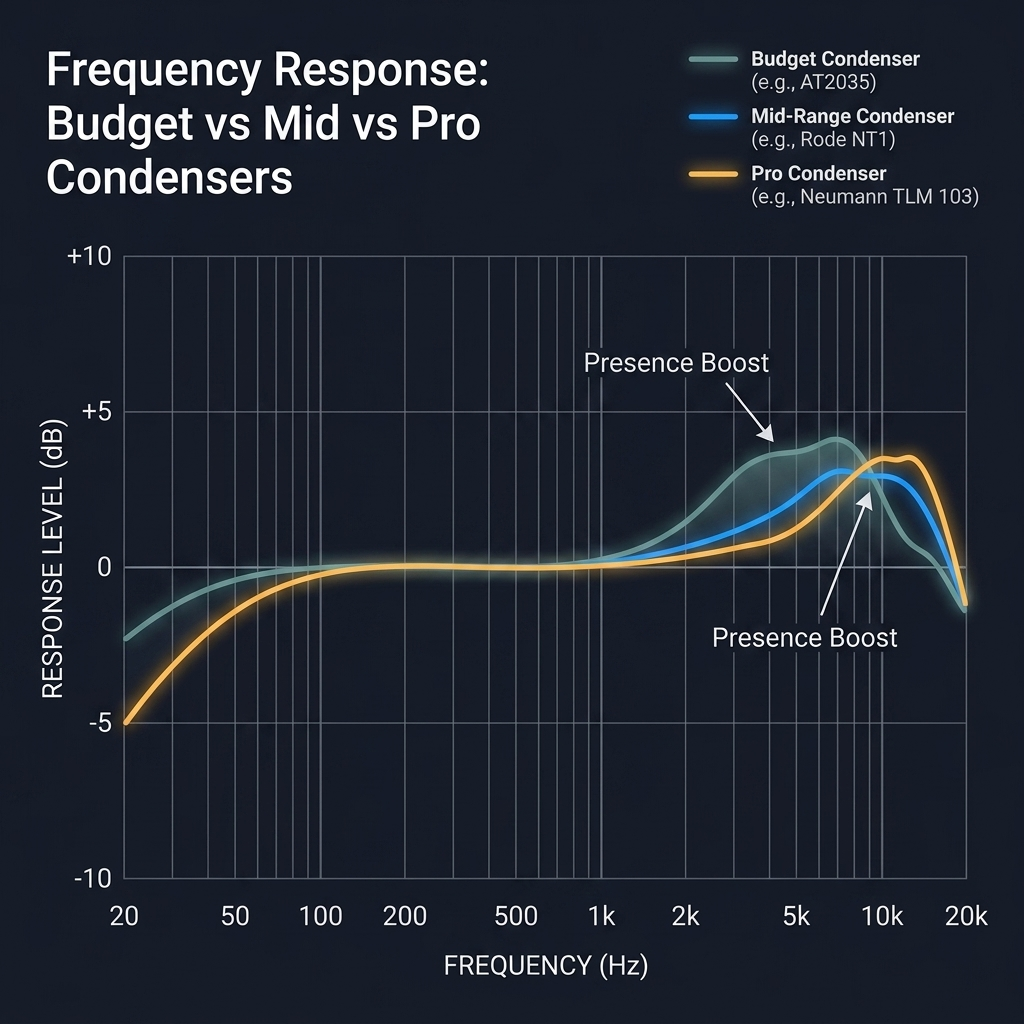
The signature character of the TLM 103 is a gentle presence boost above 5 kHz, giving vocals a natural shimmer and "air" that makes them sit beautifully in a mix without requiring heavy EQ. It is particularly well-suited for rap, R&B, pop, and any genre where the lead vocal needs to be upfront and clear.
A Note on What It Is Not
The TLM 103 is a fixed cardioid microphone. You cannot switch polar patterns. It does not come with a shockmount, which is a genuine frustration at this price. And it can be unforgiving in untreated rooms because its sensitivity captures everything. If your room is not acoustically treated, this mic will reveal every flaw.
That said, when you put it in a good room with a good singer, the results are genuinely difficult to argue with.
Pros: Industry standard sound quality. Very low self-noise at this price tier. Transformerless design for high headroom. Excellent transient response and clarity.
Cons: No switchable polar patterns. Does not include a shockmount. Not ideal for untreated home studios. Significant price jump over mid-range options.
Best Paired With: Universal Audio Volt 276, Apollo Twin, or RME Babyface Pro. Who is it for: Professional recording artists, dedicated home studio engineers, and vocalists who are serious about investing in long-term quality.
3. Audio-Technica official specifications AT2035: The Budget Champion
Price: Approximately $149 | Polar Pattern: Cardioid | Frequency Response: 20 Hz to 20,000 Hz | Self-Noise: 12 dB(A) | Max SPL: 148 dB (with pad) | Connectivity: XLR | Phantom Power Required: Yes, 48V
Here's a real-world example. A podcast host I work with, Farrukh, runs an education channel with over 50,000 subscribers. He has been using the Audio-Technica AT2035 for three years, and his listeners consistently praise his audio quality. He recently tested a $500 mid-range mic side by side with his AT2035, recorded the same segment twice, and posted both clips in a community poll. More than 60% of his listeners could not tell the difference.
That's the magic of the AT2035.
It features a smooth, balanced frequency response that is accurate and natural. No hyped high end, no exaggerated bass. Just an honest representation of what your voice actually sounds like, which is exactly what you want when your plan is to process the vocal in a DAW afterward.
It also includes an 80 Hz high-pass filter switch and a -10 dB pad, making it more flexible than its price tag suggests. The build quality is solid and feels professional in your hand.
Where It Falls Short
At 12 dB(A) of self-noise, it is noticeably noisier than the Rode NT1 5th Gen. This will not matter for podcasting or vocal recording at normal volumes, but if you are recording very quiet, delicate performances in an already noisy environment, you may notice a slight hiss on close listening.
Pros: Excellent sound quality for the price. Comes with a shockmount and a protective pouch. High-pass filter and pad included. Handles high SPLs well up to 148 dB with pad.
Cons: Self-noise at 12 dB(A) is not class-leading. Cardioid only, no pattern switching. Does not include a pop filter.
Best Paired With: Focusrite Scarlett Solo or PreSonus AudioBox USB 96. Who is it for: Beginners, podcasters, streamers, and anyone who needs a reliable, professional-sounding vocal mic without spending more than $150.
4. AKG C414 XLII: The Most Versatile Condenser Mic You Can Own
Price: Approximately $999 | Polar Pattern: 9 switchable patterns | Frequency Response: 20 Hz to 20,000 Hz | Self-Noise: 6 dB(A) | Max SPL: 158 dB (with pad) | Connectivity: XLR | Phantom Power Required: Yes, 48V
The AKG C414 has been a staple in professional recording studios since the 1970s. The XLII is the current version, tuned with a subtle high-frequency lift that makes it particularly flattering on vocals. With 9 switchable polar patterns, 4 selectable low-cut filters, and 3 pad settings, it is the Swiss Army knife of studio microphones.
For vocal recording specifically, the cardioid setting is where most engineers start. The C414 XLII has a gentle presence boost in the 3 to 10 kHz range, which gives female vocals in particular a wonderful brightness and definition. Many seasoned engineers who have worked with both the TLM 103 and the C414 XLII will tell you the C414 handles female vocals better, while the TLM 103 edges ahead for male rap and R&B.
The self-noise of 6 dB(A) is outstanding, nearly as quiet as the Rode NT1 5th Gen at a much higher price tier. Combined with a maximum SPL of 158 dB with the pad engaged, this mic can handle anything from a whispering vocalist to a screaming rock singer without breaking a sweat.
It comes with a full accessory kit including a shockmount, windscreen, pop filter, and aluminum case, which justifies a portion of the price premium over the TLM 103.
The Honest Downside
The C414 XLII costs roughly the same as the TLM 103, and the choice between them really comes down to use case. If you only record vocals and you are set on one microphone for life, the TLM 103 has a more specialized vocal character. If you record multiple instruments, want flexibility in polar patterns, and need one mic to do everything, the C414 XLII wins decisively.
Pros: 9 switchable polar patterns for extreme versatility. Self-noise at just 6 dB(A). Comes with comprehensive accessories including case. Excellent on a wide range of vocal types and instruments.
Cons: High price point. Can sound slightly bright on some voices. Requires a quality preamp to truly shine.
Best Paired With: Universal Audio Volt 476, RME Babyface Pro, or SSL 2+. Who is it for: Working studio engineers, versatile recording setups, and vocalists who also want one mic to cover acoustic guitar, overheads, and room recording.
5. sE Electronics sE2200: The Mid-Range Gem
Price: Approximately $200 | Polar Pattern: Cardioid | Frequency Response: 20 Hz to 20,000 Hz | Self-Noise: 10 dB(A) | Max SPL: 145 dB | Connectivity: XLR | Phantom Power Required: Yes, 48V
The sE2200 has a quiet but seriously impressive pedigree. It was used on vocal sessions by Amy Winehouse, among others, and has quietly become a standard in working mic lockers around the world. At around $200, it punches significantly above its weight.
The sound character of the sE2200 is flat and accurate, meaning it does not add color or character to your voice. What you record is what you hear. This is ideal if you are planning to process your vocals heavily in a mix, if you are recording voiceovers that need to sound natural and uncolored, or if you simply want honest feedback on what your actual voice sounds like.
For baritone and lower-register voices in particular, the sE2200 handles low frequencies with control and warmth that many mics in this price range struggle to achieve. If the Rode NT1 5th Gen sounds slightly too bright for your voice, the sE2200 is often the next step to try.
It includes a high-pass filter switch and a -10 dB pad, comes with a shockmount, and is built with a solid metal body that feels far more expensive than its price suggests.
Pros: Flat, honest frequency response, great for processing. Works particularly well with lower-register voices. Includes shockmount and pad. Used by professional artists on major label recordings.
Cons: No polar pattern switching. Self-noise at 10 dB(A) is decent but not exceptional. The flat response can sound less exciting on bright voices.
Best Paired With: Focusrite Scarlett 2i2 or PreSonus Studio 24c. Who is it for: Vocalists with deeper or richer voices, voiceover artists, and anyone upgrading from an entry-level USB mic who wants a neutral, accurate sound.
6. Aston Spirit: The Boutique British Condenser
Price: Approximately $399 | Polar Patterns: 3 switchable — cardioid, omnidirectional, figure-8 | Frequency Response: 20 Hz to 20,000 Hz | Self-Noise: 10 dB(A) | Max SPL: 137 dB | Connectivity: XLR | Phantom Power Required: Yes, 48V
The Aston Spirit is a bit of an anomaly. Built in the UK with a unique stainless steel wave-form mesh head, it looks completely different from any other microphone on this list. More importantly, it sounds different too.
When MusicRadar tested the Aston Spirit in their 2026 condenser mic roundup, they described it as "excellent value for money that boasts top-tier build quality." That assessment matches what I have heard from multiple engineers who keep an Aston Spirit in their locker specifically for vocals.
What makes the Spirit special is how it handles warmth. Unlike the Rode NT1 5th Gen's slightly analytical brightness or the sE2200's flat accuracy, the Aston Spirit has a naturally flattering vocal character. The built-in stainless steel wave mesh head eliminates the need for a separate pop filter in most situations, and the three switchable polar patterns give you real flexibility.
The 137 dB maximum SPL is slightly lower than some competitors, so it is better suited for standard vocal levels than extreme dynamics or loud instruments. But as a dedicated vocal microphone in a home or project studio setting, it is one of the most enjoyable mics to record with.
Pros: Three switchable polar patterns at a mid-range price. Unique stainless steel mesh head reduces plosives without a pop filter. Warm, flattering vocal character. Excellent build quality and uniquely British design.
Cons: Maximum SPL of 137 dB is lower than competitors. Can add warmth that some engineers prefer to control themselves. Less well-known than Rode or AKG, so resale value is lower.
Best Paired With: Focusrite Scarlett 2i4 or SSL 2. Who is it for: Singer-songwriters who want warmth and character in their recordings, home studio vocalists, and anyone who wants pattern switching at the $400 price point.
7. Warm Audio WA-47jr: The Vintage Character Mic
Price: Approximately $399 | Polar Patterns: 3 switchable — cardioid, omnidirectional, figure-8 | Frequency Response: 20 Hz to 20,000 Hz | Self-Noise: 11 dB(A) | Max SPL: 147 dB, up to 157 dB with pad | Connectivity: XLR | Phantom Power Required: Yes, 48V
If someone handed me $400 and said "buy a mic that sounds expensive," I would come home with the Warm Audio WA-47jr.
This microphone is Warm Audio's modern take on the legendary vintage Neumann FET 47, a microphone that was used on countless landmark recordings in the 1960s and 70s and now sells used for several thousand dollars. The WA-47jr uses a custom k47-style capsule, the same type found in vintage U47 microphones, built with high-quality Toshiba transistors and WIMA film capacitors.
The result is a microphone that sounds warmer, smoother, and more "analog" than almost anything else in this price category. There is a depth and richness to vocals recorded through the WA-47jr that is genuinely difficult to achieve with a modern, flat-response condenser.
MusicRadar, in their updated 2026 guide, listed the WA-47jr under "Best versatility" and described its character as "vintage voicing in a modern mic." That is exactly right.
A Real-World Case Study
A music producer friend of mine switched from the Rode NT1-A to the WA-47jr for her vocal sessions with indie-pop artists. Within two months, she noticed she was spending roughly 30% less time on vocal processing in the mix. The warmth and smoothness of the WA-47jr meant the raw recordings already sat well in the mix without heavy EQ or compression. Less work, better results.
Pros: Genuine vintage character derived from classic k47-style capsule. Three switchable polar patterns including figure-8 for mid-side recording. High maximum SPL of 147 dB, or 157 dB with pad. Sounds significantly more expensive than its price tag.
Cons: Self-noise at 11 dB(A) is adequate but not class-leading. The vintage warmth may not suit every genre — it can be "too smooth" for modern aggressive sounds. Requires a decent preamp to bring out its full character.
Best Paired With: Universal Audio Volt 176, Focusrite Scarlett 4i4, or PreSonus Studio 68c. Who is it for: Vocalists recording indie, folk, jazz, or any genre where warmth and character matter more than clinical transparency.
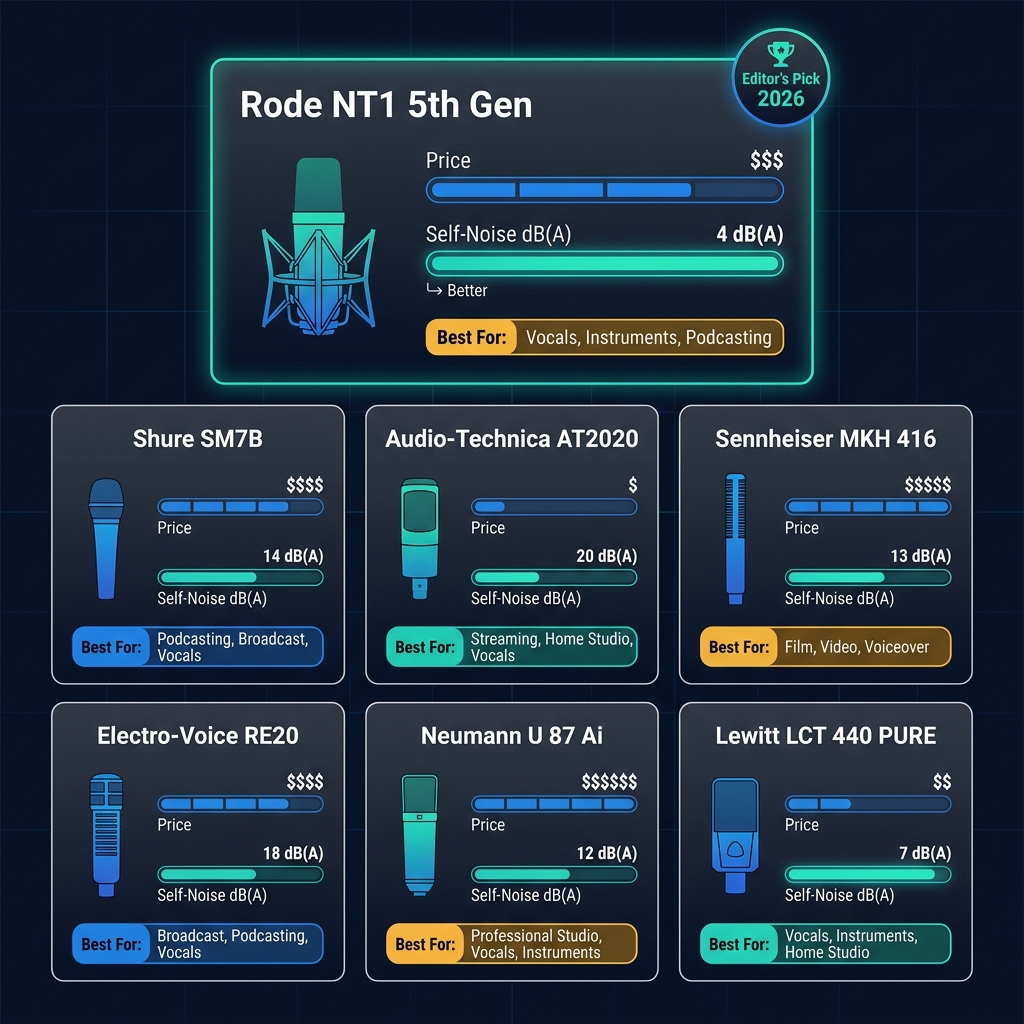
Quick Comparison: All 7 Mics at a Glance
| Microphone | Price | Self-Noise | Polar Pattern | Best For | Rating |
|---|---|---|---|---|---|
| Rode NT1 5th Gen | $249 | 4 dB(A) | Cardioid | Best overall value | 9.5/10 |
| Neumann TLM 103 | $1,100 | 7 dB(A) | Cardioid | Pro studio vocals | 9.8/10 |
| Audio-Technica AT2035 | $149 | 12 dB(A) | Cardioid | Budget beginners | 9.0/10 |
| AKG C414 XLII | $999 | 6 dB(A) | 9 patterns | Versatile pro use | 9.7/10 |
| sE Electronics sE2200 | $200 | 10 dB(A) | Cardioid | Neutral/accurate | 8.8/10 |
| Aston Spirit | $399 | 10 dB(A) | 3 patterns | Warm home studio | 8.9/10 |
| Warm Audio WA-47jr | $399 | 11 dB(A) | 3 patterns | Vintage character | 9.2/10 |
Best Bang-for-Buck Pick: Rode NT1 5th Generation. Nothing at this price comes close to combining low self-noise, included accessories, and professional vocal clarity.
How to Choose the Right XLR Condenser Mic for Your Setup
Every microphone on this list is excellent. The right one for you depends on three specific factors.
Your Budget
Under $200: The Audio-Technica AT2035 is the only real answer. It punches above its weight and gives you a genuinely professional starting point.
$200 to $400: Here the decision gets interesting. The Rode NT1 5th Gen at $249 is the safest, most well-rounded choice. The sE2200 at $200 is better for deeper voices. The Aston Spirit and WA-47jr at $399 are better if you want character and pattern flexibility.
$500 and above: The AKG C414 XLII at $999 is the most versatile investment. The Neumann TLM 103 at $1,100 is the best pure vocal microphone money can buy in this range without going into true boutique territory.
Your Room Situation
This matters more than most people admit. If your room is untreated — parallel walls, no acoustic panels, noticeable echo — the Rode NT1 5th Gen and the Audio-Technica AT2035 are forgiving enough to still deliver good results. Their lower sensitivity means they do not brutally expose every room flaw.
The Neumann TLM 103 and the AKG C414 XLII, on the other hand, are so sensitive and revealing that they will pick up every flutter echo and reflection. Those microphones belong in treated rooms.
Your Voice Type
Bright or thin voice: Go warmer. The WA-47jr or the Aston Spirit will add body and smooth out harshness.
Rich, full, or bassy voice: Go flatter. The sE2200 or the AT2035 will let your natural warmth come through without adding excess weight.
Versatile or ensemble voice: The AKG C414 XLII covers every vocal type well across its different polar patterns and is the best single mic for recording multiple different vocalists.
Common Mistakes People Make When Buying a Condenser Mic
These are real mistakes, and most of them are preventable.
Mistake 1: Spending $1,000 on a Mic but $50 on an Interface
Your microphone is only as good as the chain behind it. A Neumann TLM 103 into a low-quality interface with a noisy preamp will sound worse than a Rode NT1 5th Gen into a Focusrite Scarlett. As a rough guideline, spend at least 30 to 40% of your microphone budget on your audio interface.
Mistake 2: Skipping Acoustic Treatment
A $500 condenser microphone in an untreated room with hard walls will capture the room as much as it captures your voice. Even basic measures like recording in a closet full of clothes, adding a reflection filter behind the mic, or hanging thick curtains on parallel walls can make a significant difference.
Mistake 3: Ignoring Self-Noise Specifications
Self-noise is measured in dB(A). Lower is better. Anything below 10 dB(A) is excellent. Anything above 15 dB(A) can introduce audible hiss on quiet recordings. Always check this spec before buying.
Mistake 4: Forgetting the Pop Filter
A plosive — the burst of air you produce when saying the letters P and B — can clip a condenser microphone instantly. A basic foam windscreen is not enough for studio recording. A proper mesh pop filter, either mounted on a separate arm or built into the mic like the Aston Spirit, is essential.
Mistake 5: Choosing Based on Looks
Half the microphones that look beautiful on YouTube channels were chosen because they photograph well, not because they sound the best for the application. Always listen to comparison videos and check actual specifications before making a decision.
Frequently Asked Questions About XLR Condenser Microphones
Q1. Do I really need an audio interface to use an XLR condenser microphone?
Yes, absolutely. XLR condenser microphones require an audio interface or mixer for two reasons. First, they need 48V phantom power to operate. Second, the XLR signal is analog and needs to be converted to digital before your computer can record it. Good starter interfaces like the Focusrite Scarlett Solo ($120) or PreSonus AudioBox USB 96 ($100) provide everything you need.
Q2. What is the best XLR condenser microphone for recording vocals at home in 2026?
For most home studio situations, the Rode NT1 5th Generation at around $249 is the best choice. Its self-noise of 4 dB(A) is extraordinarily low, the included accessories are excellent value, and it performs well even in moderately untreated rooms. If your budget extends to $400, the Warm Audio WA-47jr adds vintage character that is difficult to achieve otherwise.
Q3. What does self-noise mean, and why does it matter?
Self-noise is the noise a microphone generates on its own, even when the room is completely silent. It is measured in dB(A). The lower the number, the quieter the microphone, and the cleaner your recordings. A mic with 4 dB(A) like the Rode NT1 5th Gen is nearly inaudible. A mic with 20 dB(A) or above will introduce a faint but noticeable hiss, especially on quiet passages.
Q4. Can I use an XLR condenser microphone for podcasting?
Definitely. Condenser microphones are actually preferred for podcast recording because of their clarity and detail, especially for voice. The Audio-Technica AT2035 and the Rode NT1 5th Gen are particularly popular in podcast setups. Just make sure your room is reasonably quiet and treated, since condenser mics pick up more background noise than dynamic mics.
Q5. Is the Neumann TLM 103 worth the $1,100 price tag?
For professional recording use, yes. The TLM 103 has been the industry benchmark for studio vocal recording for nearly three decades. Its self-noise of 7 dB(A), transformerless design, and natural high-frequency presence make it genuinely difficult to improve upon at this price point. That said, for home studios with untreated rooms or budgets under $500, the Rode NT1 5th Gen or the Warm Audio WA-47jr deliver 85 to 90% of the result at a fraction of the cost.
Q6. What is the difference between the AKG C414 XLII and XLS?
Both are excellent mics but tuned differently. The C414 XLII has a slight high-frequency presence boost, making it brighter and more flattering on vocals, especially female voices. The C414 XLS has a flatter frequency response, making it more accurate and neutral, which is preferred for instruments and situations where clinical accuracy matters more than flattery.
Q7. How long do XLR condenser microphones last?
With proper care, a quality XLR condenser mic can last 20 to 30 years or more. The original AKG C414 models from the 1980s and 1990s are still in active use in professional studios today. Store them in a dry environment, avoid dropping them, and never leave them exposed to humidity.
Conclusion: The Right Microphone Is Waiting for You
Choosing a microphone is one of the most personal decisions you'll make in your recording journey. The best XLR condenser microphone for vocal recording isn't necessarily the most expensive one. It's the one that matches your voice, your room, and the music you make.
If you're just starting out, the Audio-Technica AT2035 or the Rode NT1 5th Generation will serve you remarkably well and won't hold you back for years. If you're ready to invest in a professional-grade sound, the AKG C414 XLII or the Neumann TLM 103 are genuinely lifetime purchases.
Remember that the microphone is just the first part of the chain. For more on how to clean up your recordings once you've tracked them, check out our guide on Why Audio Quality Matters More Than Video or learn how to Remove Background Noise Without Making Voice Robotic.
Transparent Disclosure: The author is the Founder of Audio Forge Pro. Recommendations reflect genuine relevance to this topic. Core audio processing is free with no login required.