
Why Sped-Up TikTok Audios Went Viral (How to Make One) — complete guide
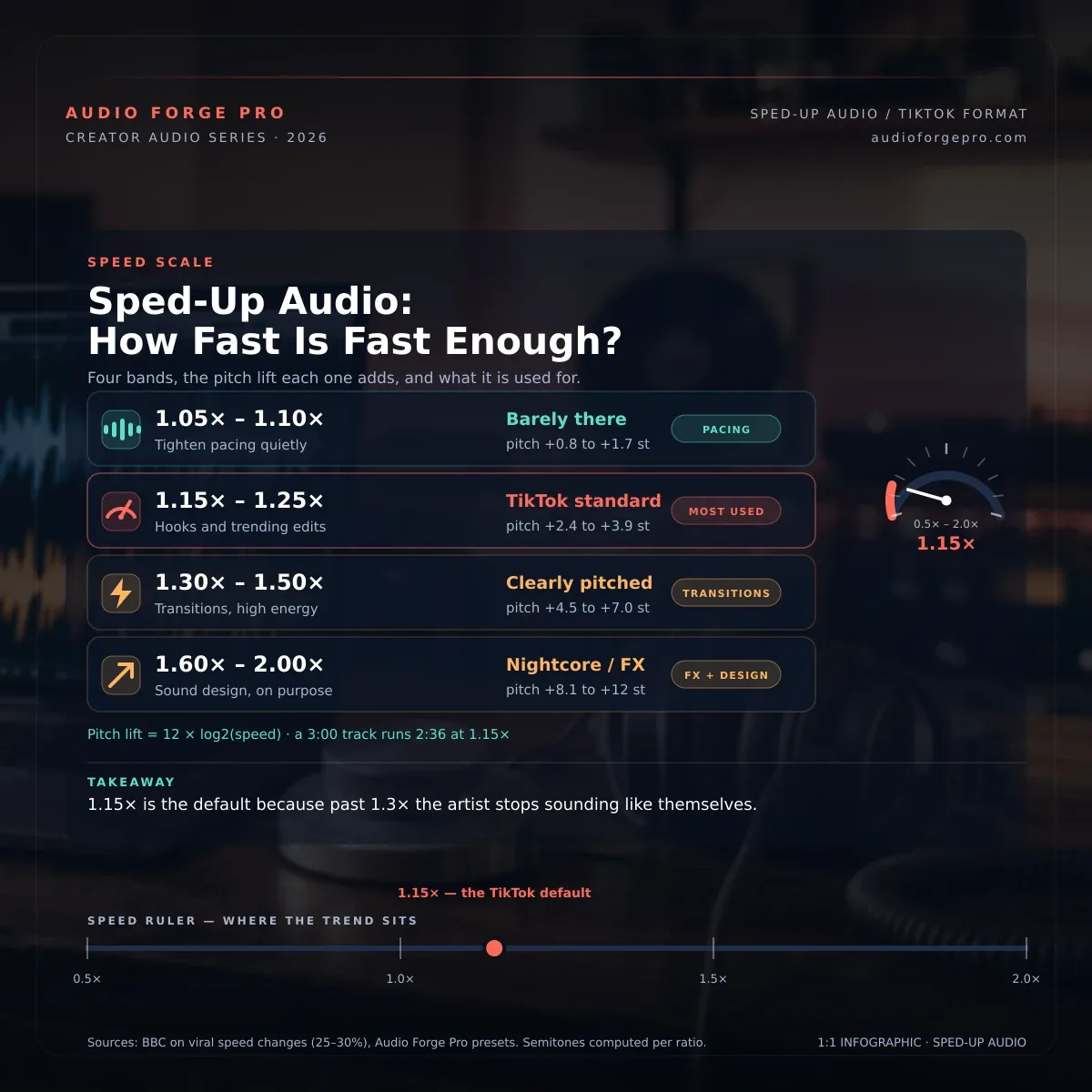
Sped-up audio is a song played back faster than it was released, usually 15-30%, with the pitch rising along with the tempo. On TikTok it became the default remix style somewhere around 2020, and in 2026 labels now ship official sped-up versions alongside the single. At 1.15x a three-minute track becomes 2:36 and the vocal sits 2.4 semitones higher. That is the whole trick.
You already know how it sounds. A familiar song starts and for half a second your brain flags it as wrong, in a good way. Brighter, tighter, more urgent. Nothing in the recording changed. The playback speed did.
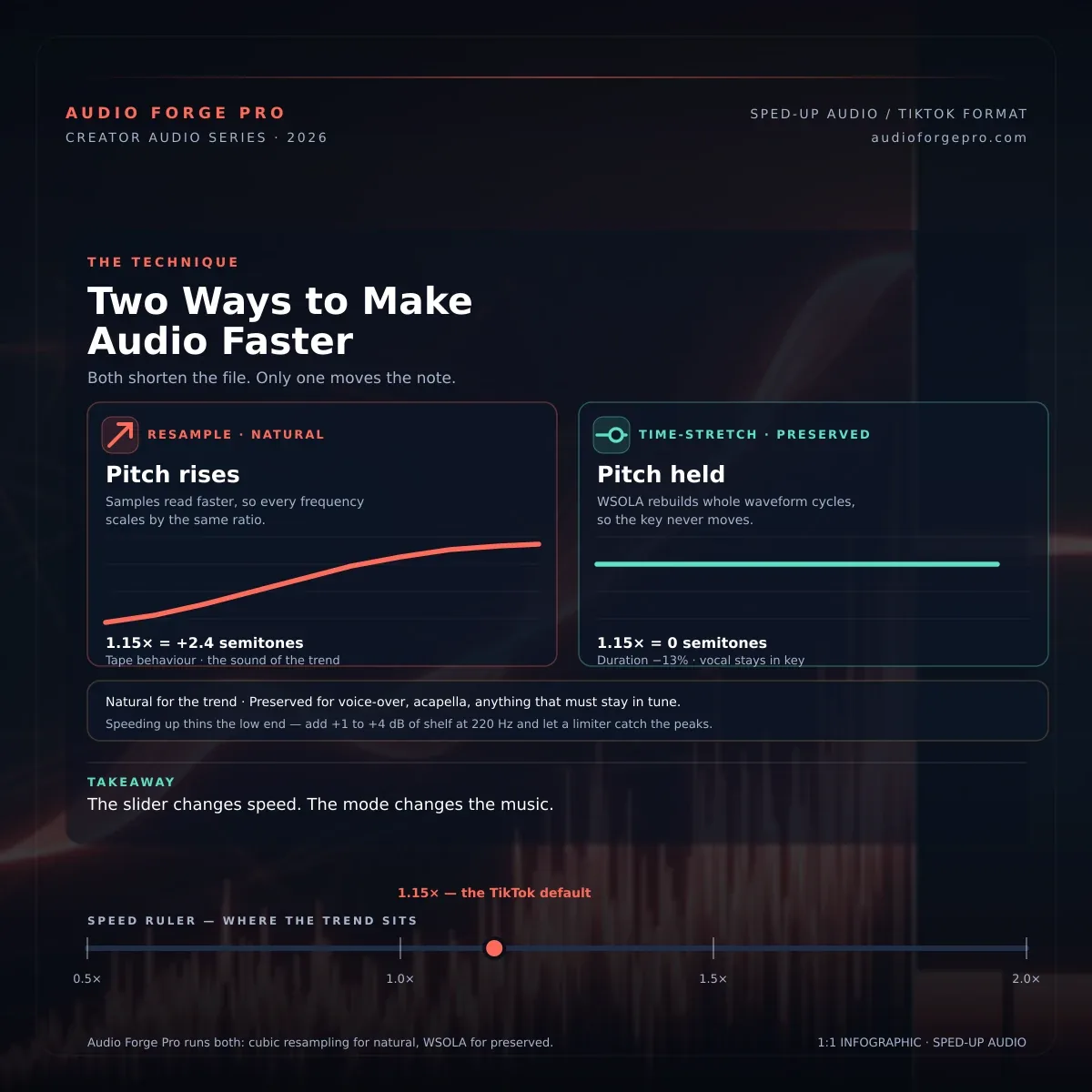
Here is the part most guides skip: there are two completely different ways to make audio faster, and only one of them gives you the sound the trend is built on.
Why a 25% Faster Song Feels Like a New Song
Tempo reaches a listener before the lyrics do. Listeners consistently rate faster music as higher in arousal (more energy, more urgency), regardless of whether the song is happy or sad. That is why a sped-up ballad can read as a dance track without a single note being re-recorded.
Pitch stacks on top of that. Raising a vocal by 2.4 semitones shifts its formants upward, which pushes the voice toward the range human hearing is most sensitive to. The performance is identical, but it arrives brighter and more forward in the mix.
There is also a platform reason. A hook that takes four seconds to land at 1.0x arrives sooner at 1.15x, and on a feed where the first three seconds decide everything, sooner is the point. Most creators are not running a psychology playbook when they drag the slider; they speed a track up because it sounds better to their ear in that moment. The tempo-arousal effect explains why that instinct keeps landing on the same numbers.
The Trend, in Numbers That Actually Exist
Most articles about sped-up audio stay vague. The published numbers are more interesting:
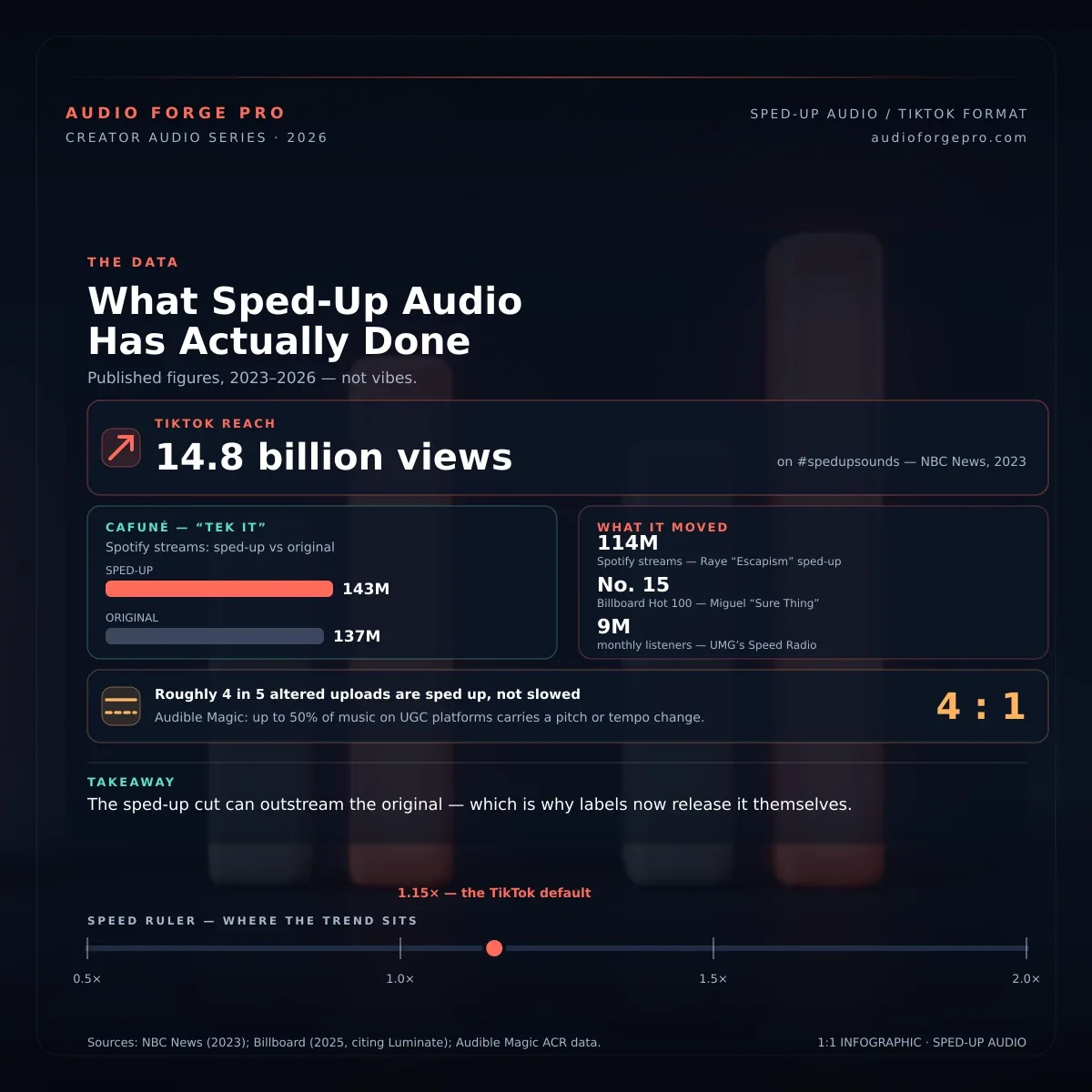
- NBC News reported in 2023 that #spedupsounds had passed 14.8 billion views, and Music Business Worldwide had it at 17.8 billion a few months later, with individual remix accounts pulling millions of followers from speed changes alone.
- Raye, the British singer-songwriter Rachel Keen, watched "Escapism" slide in its first week (Luminate data, via Billboard) until a homemade sped-up version took over TikTok. Her label answered with an official uptempo rework, and Billboard reported it past 114 million Spotify streams.
- Cafuné is the New York duo of Sedona Schat and Noah Yoo, and "Tek It" is the cleanest case of the tail wagging the dog: 137 million Spotify streams for the 2019 original, around 143 million for the sped-up cut, both per Billboard.
- Miguel's 2010 single "Sure Thing" had stalled at No. 36 in 2011. A sped-up version pushed it from 81 to 105 BPM (The Ringer), became a top sound on TikTok in early 2023 and carried the song to No. 15 on the Hot 100, twelve years after release.
- UMG runs a Spotify account called Speed Radio with more than 9 million monthly listeners; Spotify's own Sped Up Songs playlist passed 1 million followers.
| Version | Reported streams | What it shows |
|---|---|---|
| Raye: Escapism (sped-up) | 114M+ Spotify | Already sliding when the remix took over |
| Cafuné: Tek It (sped-up) | ~143M Spotify | Outstreamed the original release |
| Miguel: Sure Thing (sped-up) | No. 15 Billboard Hot 100 | Charting again twelve years later |
On the detection side, audio-recognition company Audible Magic says as much as 50% of the music uploaded to user-generated platforms carries a pitch or tempo change, and that sped-up edits outnumber slowed ones roughly four to one.
Where the Sound Came From
Nightcore is the ancestor, and the dates usually get fumbled. It started in Norway in 2001-2002 as a school project by two students, Thomas S. Nilsen and Steffen Ojala Søderholm, who sped up trance and Eurodance records and pitched them higher. The template they set (roughly 25% faster, landing around 160-180 BPM) is still what "nightcore" means. Their tracks reached YouTube in 2006.
Short-form video picked it up through Musical.ly, which launched in 2014 with built-in speed options (time-lapse, fast, normal, slow, epic). ByteDance merged Musical.ly into TikTok in 2018, and the speed slider came with it. By late 2019 a sped-up "Roman Holiday" had been used in over 800,000 videos. Through 2020-2022 the sound spread from fan edits into label strategy, and by 2023 artists were releasing faster versions on purpose.
The Speeds That Actually Work
| Setting | What it sounds like | Use it for |
|---|---|---|
| 1.05x to 1.10x | Barely perceptible lift | Tightening pacing without announcing it |
| 1.15x to 1.25x | The TikTok sound | Most trending edits and hooks |
| 1.30x to 1.50x | Obviously pitched up | Transition edits, high-energy cuts |
| 1.60x and up | Nightcore / sound design | When the pitch shift is the joke |
What most people call the TikTok sped-up sound is a 20% to 30% lift, and 1.25x (a quarter faster, so 3:00 becomes 2:24) is the setting that turns up in tutorial after tutorial. BBC reporting on the trend puts the typical viral change at 25-30%. 1.15x, the preset this site ships, is the gentler version of the same move: enough lift to add urgency without losing the voice. Above 1.3x the result depends on the singer's range and how dense the instrumentation is. If you want an exact ratio between the presets, the audio speed changer takes any value from 0.5x to 2x.
Pitch: The Decision Nobody Makes on Purpose
Whatever your tool does by default is the sound you will live with, so decide it deliberately.
- Resampling (natural): shortening the file and raising pitch together. 1.15x = +2.4 semitones. This is tape behaviour and it is what the trend sounds like.
- Time-stretching (preserved): WSOLA rebuilds the waveform so duration shrinks and the key stays put. Right for voice-over, acapella, or anything that has to stay in tune.
Making One in the Browser, Start to Finish
The usual route is CapCut or a phone editor: download, import, hunt for the speed menu, export, re-upload. It works, but it is four steps for one slider. If the song is trapped inside a video, pull the audio out first with the audio extractor, then follow the same chain.
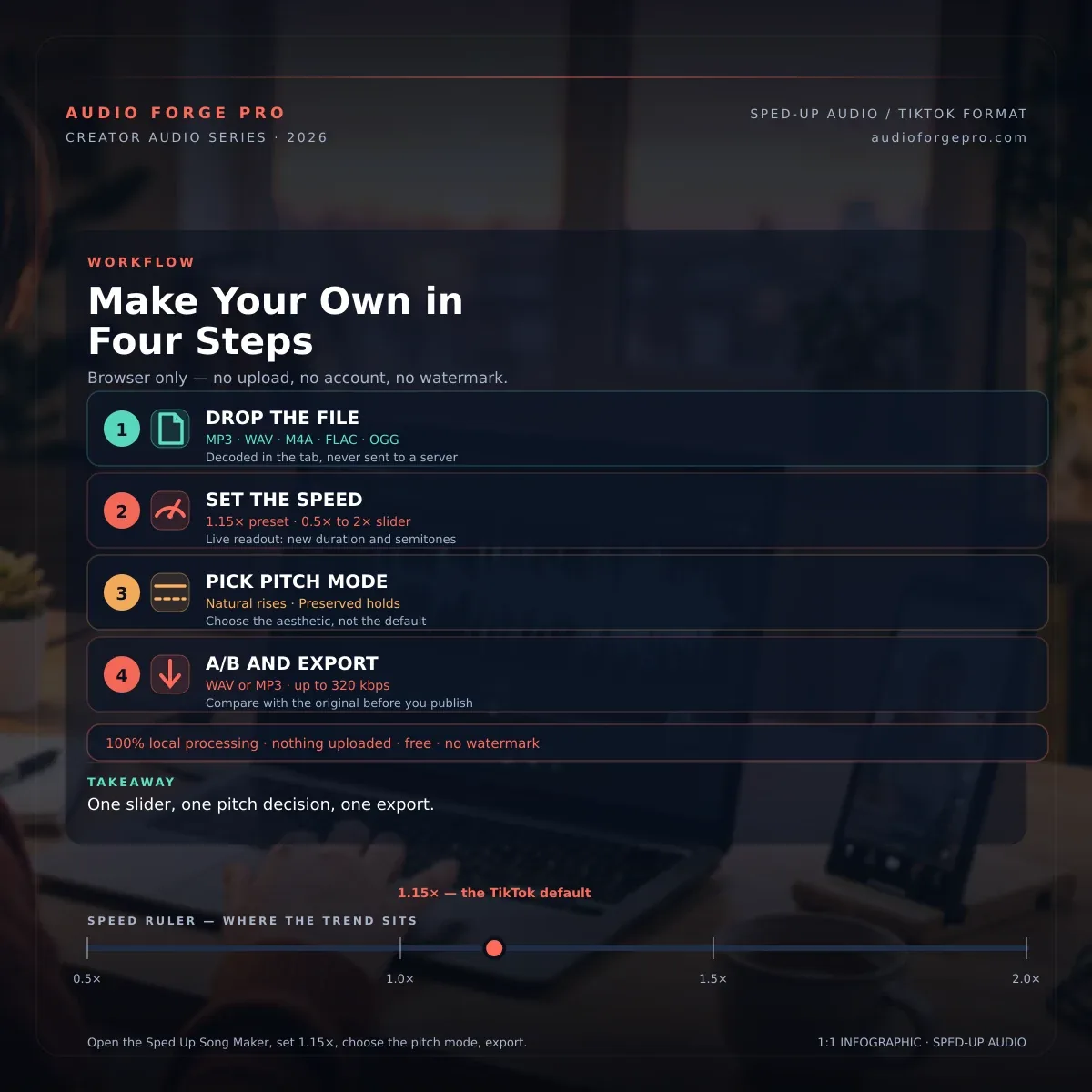
- Open the Sped Up Song Maker and drop in your file. MP3, WAV, M4A, FLAC and OGG all load. Nothing is uploaded; the audio is decoded in the tab.
- Set the speed. The 1.15x TikTok preset is the starting point; the slider runs from 0.5x to 2x, and the readout shows the new duration and the pitch shift in semitones as you move it.
- Choose pitch behaviour: natural if you want the trend sound, preserved if the vocal has to stay in key.
- A/B it against the original, then export WAV or MP3. No watermark, no queue.
For anything that needs to be trimmed first, cut the section in the audio trimmer and rejoin it afterwards.
Sped-Up vs Nightcore vs Slowed + Reverb
All three come from the same two controls. Only the direction and distance change.
| Style | Speed | Pitch | Mood |
|---|---|---|---|
| Sped-up | 1.10x to 1.30x | Rises with tempo | Energy, urgency |
| Nightcore | 1.25x to 1.50x | Rises a lot | Euphoric, anime-adjacent |
| Slowed + reverb | 0.80x to 0.90x | Stays or drops | Hazy, nostalgic |
The nightcore maker pushes both controls together on purpose, and the slowed and reverb route goes the other way with a long tail. There is also a middle setting people search for as sped up + reverb: the same lift with a tail, wetter as it drifts toward the slowed and reverb sound.
If you only want space without touching tempo, the reverb effect and echo effect tools cover it, with 8D audio for movement. Voice echo is the spoken-word option, and it beats pitching a whole track just to sound different.
Copyright: What Changed in 2026
Speeding a song up does not change who owns it. A sped-up edit is a derivative of the master, and fingerprinting systems are built to survive the change; small pitch and tempo shifts are exactly what they are trained on. TikTok's audio fingerprinting and YouTube's Content ID both identify altered recordings.
2026 made that harder to ignore. TikTok's distribution arm SoundOn rolled out ACRCloud derivative-works detection into its ingestion pipeline, which flags sped-up, slowed and pitch-shifted uploads and routes royalties back to the rights holder. In May 2026 UMG and TikTok renewed their licensing deal with enforceable commitments on unauthorised AI music and attribution. Before that, TikTok walked away from Merlin negotiations in late 2024 citing manipulated versions of existing recordings.
Four Mistakes That Kill a Good Edit
- Speeding past recognition. If the listener cannot place the song, the edit loses the familiarity it was trading on.
- Leaving the pitch mode on whatever the tool defaulted to. Rising and preserved are different aesthetics, not a quality setting.
- Starting from a 96 kbps rip. Speed changes make compression artefacts more audible, not less, which is the argument in why audio quality matters.
- Skipping the A/B check. A speed that flatters one vocal range makes the next one thin.
Sped-up audio really is two controls and a judgement call. Pick a speed between 1.1x and 1.3x, decide whether the pitch should move, listen against the original, and export. If you are cutting this for Shorts, the pacing guide and the Shorts audio setup guide cover the rest of the chain.
Transparent Disclosure: The author is the Founder of Audio Forge Pro. Recommendations reflect genuine relevance to this topic. Core audio processing is free with no login required.
Responses
Join the community discussion. Sign in with Google to post a comment after the page finishes loading.