
Article content
Slowed + reverb is a resample followed by a long reverb tail. At 0.85x, a 120 BPM song drops to 102 BPM, the vocal falls 2.8 semitones, and a 3:00 track runs 3:32. Nothing is re-recorded and no note changes. That is the whole edit.
Why it feels good has three separate answers: a slower tempo is a measured low-arousal cue, a long reverb tail is a measured distance cue, and a familiar song is a strong trigger for autobiographical memory. Plenty of guides on this topic make confident claims about the nervous system without citing a study. We checked the research, the history, and our own tool's settings, and we label interpretation as interpretation.
What Actually Changes in the File
There are two ways to slow audio, and only one produces the sound this format is named after. Resampling plays the samples back more slowly: tempo and pitch fall together, exactly like dragging a record or a tape. Time-stretching (WSOLA and related algorithms) inserts or removes small slices to change duration while holding the original pitch, so the singer stays in key.
Classic slowed and reverb uses the first method. The Slowed and Reverb Generator calls it Natural mode; its Preserved mode does the second, which is useful for spoken word but removes the lower vocal that people recognise as the effect. The pitch difference is not subtle: at 0.85x it is 2.8 semitones, close to three frets on a guitar.
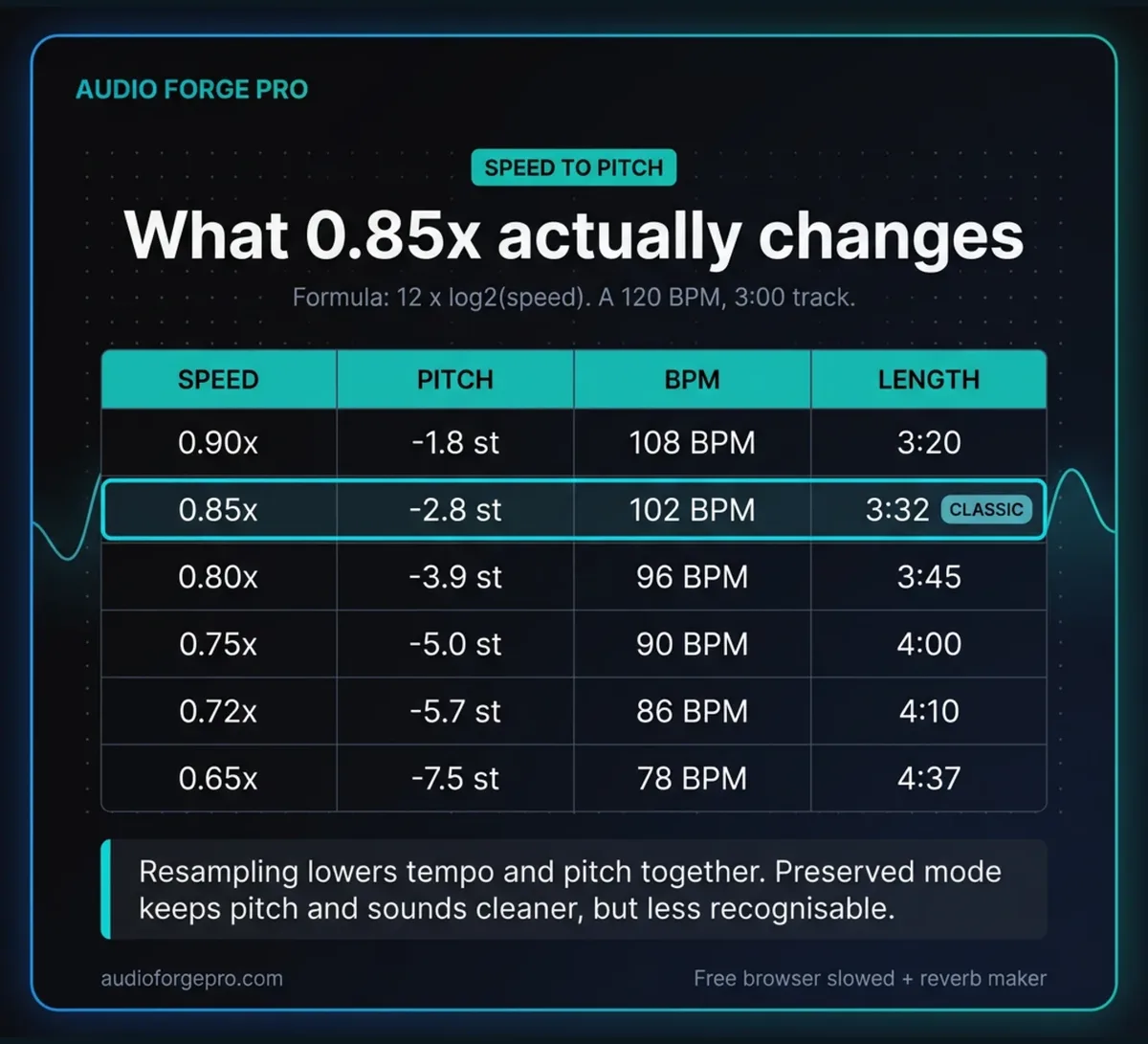
The table below is calculated for a 120 BPM, 3:00 track. The numbers are arithmetic, not taste. The pitch column comes from 12 x log2(speed), the tempo column from 120 x speed, and the length column from 3:00 / speed.
| Speed | Pitch change | Tempo | Track length |
|---|---|---|---|
| 0.90x | -1.8 st | 108 BPM | 3:20 |
| 0.85x | -2.8 st | 102 BPM | 3:32 |
| 0.80x | -3.9 st | 96 BPM | 3:45 |
| 0.75x | -5.0 st | 90 BPM | 4:00 |
| 0.72x | -5.7 st | 86 BPM | 4:10 |
| 0.65x | -7.5 st | 78 BPM | 4:37 |
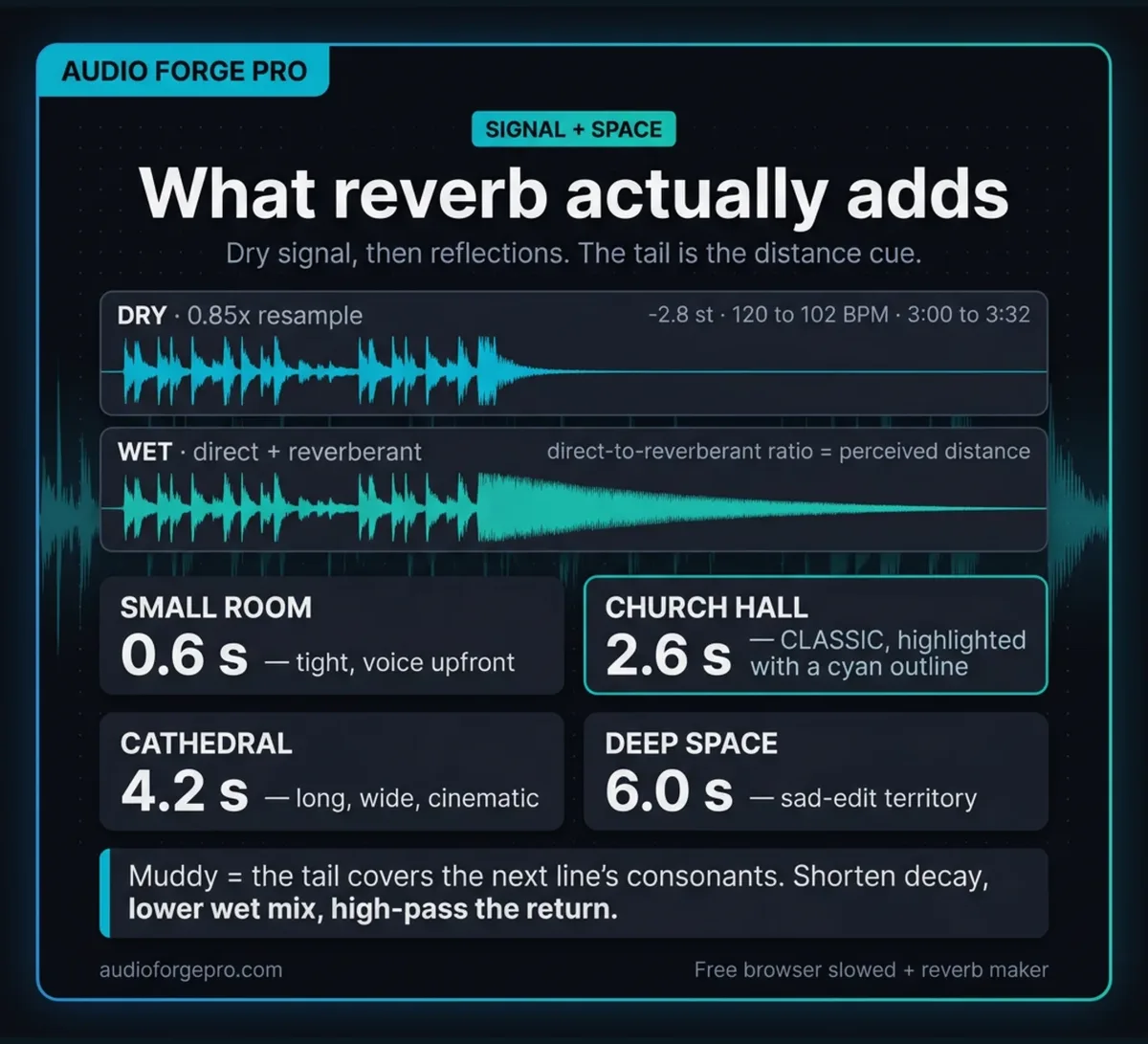
Reverb is a separate stage. Our engine runs a real convolution reverb, not a delay loop, with ten spaces ranging from a 0.6 second Small Room to a 6.0 second Deep Space. Church Hall is 2.6 seconds and Cathedral is 4.2 seconds. A long tail fills the gaps the slowdown opens up, which is why a slowed edit without reverb sounds empty rather than hazy.
Where the Format Came From
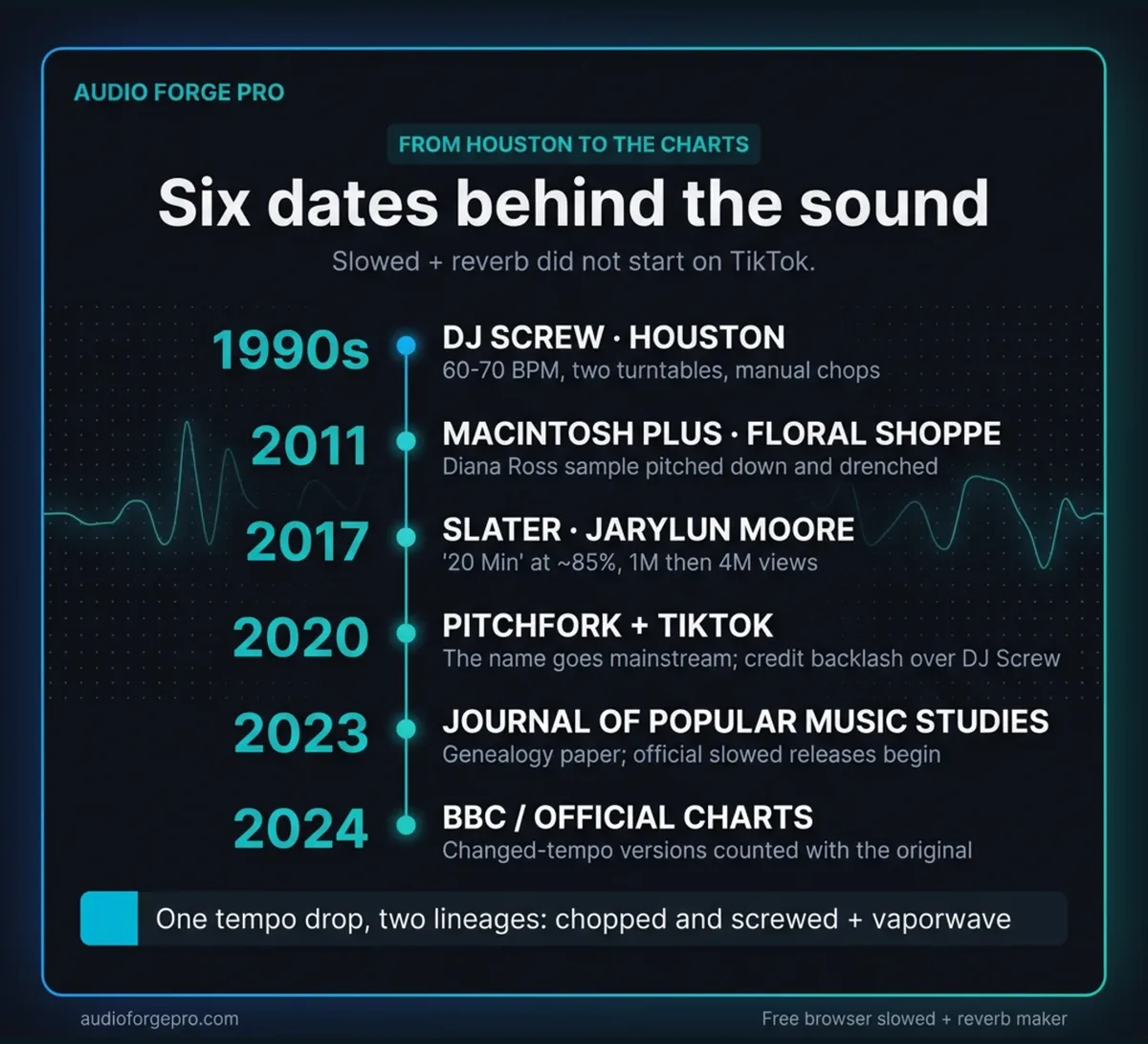
The ancestor is chopped and screwed, built by DJ Screw (Robert Earl Davis Jr.) in Houston in the early 1990s. He worked with two copies of the same record on turntables, dragged the pitch control down to roughly 60 to 70 BPM, and used the crossfader to repeat and cut phrases. Those tapes circulated locally through the Screwed Up Click and his own record shop. The University of Houston Libraries Special Collections holds the DJ Screw Collection, including personal papers, sound recordings and recording equipment. The slowdown was a performance technique, not a preset.
The simplified digital version is usually traced to Jarylun Moore, who uploaded as Slater from Houston. In 2017 he posted a version of Lil Uzi Vert's "20 Min" slowed to about 85 percent with reverb over it. Know Your Meme records more than a million views within one month and four million before removal; Wikipedia puts the first million at under two months, and Pitchfork's 2020 interview quotes Slater saying the video had around four million views before a copyright takedown. Know Your Meme reports that a 2018 reupload passed 27 million views in three years, while Pitchfork described a different copycat reupload nearing seven million by 2020. The original channel is gone, which is why exact view counts depend on the source.
In 2020, Pitchfork published Andy Cush's interview-based account of the style. Know Your Meme records an early-August TikTok explainer that credited Slater with creating the genre; Cush's article and the later academic genealogy both trace the style back to Houston's chopped-and-screwed tradition. In that interview Slater called DJ Screw the progenitor and said he did not want people to forget those roots.
There is an older branch as well. Vaporwave producers were pitching down and drenching old pop samples years before the YouTube format: Macintosh Plus (an alias of Vektroid) built "Lisa Frank 420 / Modern Computing" on a slowed, chopped take of Diana Ross's "It's Your Move" for the 2011 album Floral Shoppe. Leonard Martin traces both lineages in "Slowed + Reverb: A Pop Genealogy", published in the Journal of Popular Music Studies (35(3), 5-31, 2023, doi:10.1525/jpms.2023.35.3.5). The paper also describes the criticism that fan edits can reproduce the sound while ignoring where it came from.
Why It Feels Calm, Distant and Familiar
Three findings are solid enough to build an explanation on.
Tempo and arousal
Husain, Thompson and Schellenberg varied the tempo and mode of a Mozart sonata and found that tempo changed arousal while mode changed mood (Music Perception, 2002). Faster music raised arousal; slower music lowered it. A 2024 Food Quality and Preference study with 124 participants compared 145 BPM and 85 BPM electronic music while people ate; the slow-tempo group reported feeling calmer and spent longer eating. Neither study tested a slowed pop song, but the direction of the effect is consistent and it does not require any claim about heart rate or blood pressure.
Reverb and distance
The ratio of direct sound to reverberant sound is one of the main cues the auditory system uses to judge how far away a source is. Zahorik measured sensitivity to that ratio in the Journal of the Acoustical Society of America, 2002, and a 2016 review by Kolarik and colleagues reports just-noticeable differences of 2 to 3 dB at 0 and +10 dB DRR, with larger thresholds at very low and high ratios. It also notes that level cues can be more accurate than the ratio alone. A dry vocal is in the room with you; a vocal with a four-second tail is not. That is a spatial judgement, and it is measurable.
Familiar songs and memory
Barrett and colleagues found that familiarity and autobiographical salience were the strongest predictors of music-evoked nostalgia, stronger than personality measures (Emotion, 2010). A slowed edit is still the song you know, so the memory network has something to work with, while the changed tempo and added space keep it from being the exact recording you remember. That combination is a reasonable explanation for the "heard through a wall" description listeners keep using.
There is also a simpler, non-neurological reason the format works: slowing a dense mix exposes details. Background harmonies, the reverb already printed on the original vocal, and small percussion figures get room to be heard. Listeners often describe noticing things in a song they have played hundreds of times. That is an acoustic consequence of stretching transients, not a psychological trick.
The Settings We Ship, and Why
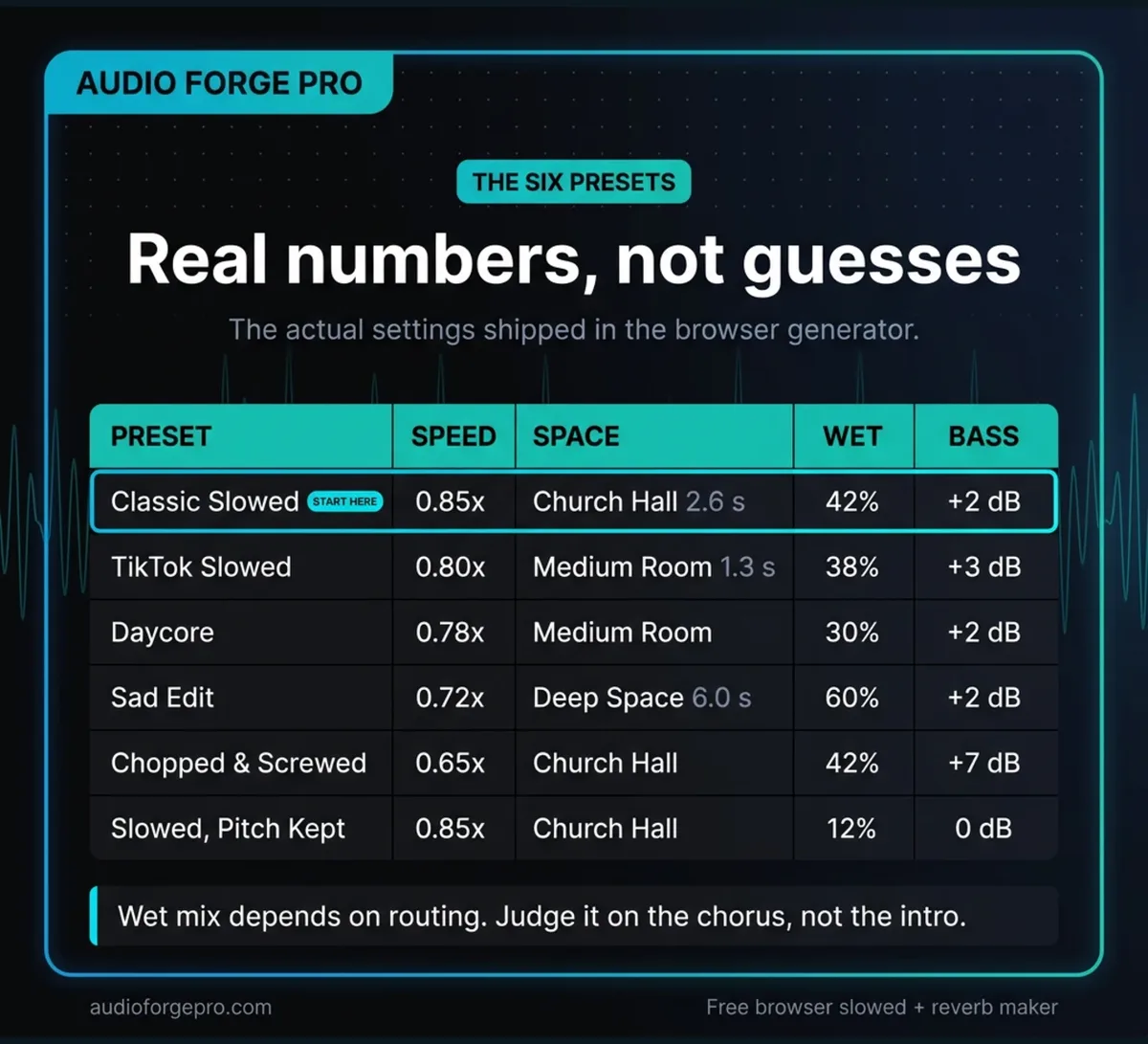
A wet mix percentage is not a universal constant. It depends on whether the reverb is a send, an insert, or a convolution return, and on how loud the tail is relative to the dry signal. The ranges below are the actual presets in our generator, so they are reproducible rather than borrowed from another site's list.
| Preset | Speed | Reverb space | Wet mix | Bass shelf |
|---|---|---|---|---|
| Classic Slowed | 0.85x | Church Hall (2.6 s) | 42% | +2 dB |
| TikTok Slowed | 0.80x | Medium Room (1.3 s) | 38% | +3 dB |
| Daycore | 0.78x | Medium Room | 30% | +2 dB |
| Sad Edit | 0.72x | Deep Space (6.0 s) | 60% | +2 dB |
| Chopped & Screwed | 0.65x | Church Hall | 42% | +7 dB |
| Slowed, Pitch Kept | 0.85x | Church Hall | 12% | 0 dB |
The classic setting is 0.85x with a 2.6 second hall at 42 percent wet. The bass shelf is small because resampling already moves the whole spectrum down; adding more than a few dB makes the low end boom instead of warm. The limiter sits after the shelf so the extra low end cannot clip the export.
Muddiness is a specific problem with a specific cause: a long tail from one line is still decaying when the next line starts, so consonants get covered. The fix is to shorten the decay or lower the wet mix, and to high-pass the reverb return so low-frequency reflections do not stack under the vocal. Our spaces apply a low cut between 55 and 220 Hz for that reason. Dense mixes need less wet signal than sparse ones, which is why the 60 percent Sad Edit preset is a deliberate special case, not a default.
Chopped and Screwed vs Slowed + Reverb vs Daycore
These are related but not interchangeable, and the distinction matters to people who grew up with the Houston tapes.
| Feature | Chopped and screwed | Slowed + reverb | Daycore |
|---|---|---|---|
| Origin | Houston, early 1990s | YouTube, late 2010s | Online remix tag |
| Speed | Roughly 60-70 BPM | 0.78x to 0.90x typical | 0.70x to 0.85x |
| Turntable work | Manual chopping, repeats, scratching | None | None |
| Reverb | Not the defining feature | Long hall or cathedral tail | Optional, often light |
| Genre | Houston hip-hop and R&B | Any genre | Any genre |
Chopped and screwed is a performance practice tied to a place and a scene. Slowed and reverb borrows the tempo drop, drops the manual edits, and adds a space effect; it works on pop, anime openings and lo-fi instrumentals. Daycore is the slowdown on its own, with pitch still falling, and reverb optional. The terms blur in playlist titles, but the production steps are different.
If you want the opposite direction, our guide to sped-up TikTok audio covers the 1.15x end of the same control, and the nightcore guide covers the 1.30x version with the semitone maths.
It Became an Official Release Format
This stopped being only a fan edit. According to BBC reporting on changed-tempo releases, the UK Official Singles Chart now combines sped-up and slowed-down versions with the original song into one chart total, alongside remixes and live versions. The Official Charts Company confirms that all versions of a track are counted together. That gives labels a direct commercial reason to publish their own versions instead of letting an unofficial upload take the streams.
Concrete examples: Billie Eilish announced a slowed and reverb digital edition of Hit Me Hard and Soft in 2024; Teddy Swims' Lose Control (Slowed Down) carries a 2024 Warner Records credit; and FIFTY FIFTY's Cupid (Twin Ver.) (Slowed Down Version) was issued as a single in 2023. These are label releases, not fan uploads.
How to Make One in the Browser
- Open the Slowed and Reverb Generator and load an audio file. The picker accepts MP3, WAV, FLAC, M4A, OGG and common phone voice-note formats, plus MP4, MOV and WebM video files. Decoding happens on your device; nothing is uploaded, there is no account and no file-size cap. If your source is a video, you can also pull the audio out first with the Extract Audio from Video tool.
- Start with the Classic Slowed preset: 0.85x, pitch following speed, Church Hall at 42 percent wet, +2 dB bass. Use the A/B control to compare it against the original before touching anything else.
- Set the speed for the material. Fast drum programming falls apart below about 0.75x; sparse piano or ambient tracks tolerate 0.72x. Above 0.90x the change is hard to hear. If you need the singer to stay in key, switch to Preserved mode and expect a cleaner but less recognisable result.
- Tune the space. Church Hall (2.6 s) and Cathedral (4.2 s) give the long decay the format is built on; Medium Room (1.3 s) keeps a busy vocal intelligible. Move the wet mix down if the words disappear, and remember the tail is rendered in full at export instead of being cut off at the last sample.
- Preview the chorus and the ending, then export WAV for a video project or MP3 up to 320 kbps for uploading. The original file is never modified. For a more surgical space edit afterwards, the dedicated reverb tool exposes damping and low-cut directly.
If the result is headed for short-form video, check the Shorts export settings and the mobile audio optimization guide before publishing; a long tail behaves differently after a phone speaker and a second platform encode.
Common Mistakes
Slowing too far for the source
At 0.65x the pitch is more than seven semitones down. That is a chopped-and-screwed effect, not a standard slowed edit, and consonants stop separating on most pop vocals. Pick the speed from the arrangement, not from a preset list.
Using pitch-preserved mode by accident
In Audacity the equivalent distinction is Change Speed versus Change Tempo; in a DAW it is resample or re-pitch versus warp. If the vocal sounds slow but normal in key, you time-stretched instead of resampling. The lower voice is the effect, so check it before exporting.
Choosing a short room and then adding more wet signal
A 0.6 second room cannot produce the distance cue people describe, and raising the mix to compensate only makes the track louder and cluttered. Use a longer decay first, then set the level. The echo effect tool explains the difference between discrete repeats and a continuous tail if the two are getting confused.
Starting from a low-bitrate file
Resampling and reverb both make existing compression artefacts easier to hear, because the tail repeats and stretches them. Start from the cleanest copy you have. A 96 kbps source will not be rescued by a 4.2 second cathedral.
Where to Go Next
Make the edit on the Slowed and Reverb Generator, then read the sped-up audio guide for the same control pushed the other way, or the nightcore maker guide for the semitone maths at 1.30x. For the space on its own, the reverb tool lists all ten spaces with their decay times.
The same browser render pipeline powers the Audio Speed Changer, Sped Up Song Maker, Nightcore Maker, 8D Audio Maker and Voice Echo Effect tools. Use those for independent tempo and pitch, the faster end of the same control, or a different kind of space on a finished vocal. Want to check the track's starting tempo and musical key before dialing in a slowdown? Run it locally through our Key & BPM Finder first.
Responses
Join the community discussion. Sign in with Google to post a comment after the page finishes loading.